Stories

Distillery legends, happy accidents, and the odd bit of trivia — the history and lore behind the names on the label.

illustration of lantern, quill, letters and newspaper
illustration of Lindores Abbey

1494 - First historical mention of whiskey

Whiskey's oldest paper trail isn't a legend — it's a tax record.

The Exchequer Rolls of King James IV, Scotland's royal financial ledgers, contain a line item from 1494 ordering "eight bolls of malt" sent to a Tironensian monk named Friar John Cor at Lindores Abbey in Fife, so he could make aqua vitae — Latin for "water of life," and the root of the word whisky itself. "To Friar John Cor, by order of the King, to make aqua vitae VIII bolls of malt."

The entry doesn't explain why the king wanted it; historians assume a royal celebration. What it does prove is that monks, not distillers, were Scotland's first whisky makers, using stills brought over for medicine and preservation.

Lindores Abbey itself fell into ruin centuries ago, but a distillery bearing its name now stands on the same ground — turning the site of whisky's first receipt back into the site of its production.

illustration of Aeneas Coffey

Aeneas Coffey (Jameson & Redbreast)

For most of the 1800s, Irish whiskey was the whiskey of the world. Dublin's distilleries were among the largest anywhere, and Irish pot still whiskey outsold Scotch by a wide margin.

Aeneas Coffey was on the other side of that business. He was an excise officer — a tax man for the British Crown, sent to collect duty from Irish distillers and shut down the illegal stills that dodged it. In 1810, on a raid in Donegal, a crowd turned on him. He was beaten, his skull was fractured, he was stabbed with bayonets, and he was left for dead.

He survived, recovered, and went back to work. But after leaving the excise service he switched sides and went into distilling himself — and in 1830 he patented a new kind of still. Instead of a pot that had to be filled, boiled, and emptied one batch at a time, Coffey's column still ran continuously, producing a lighter, purer spirit faster and far more cheaply.

He took it to Ireland's great distillers, Jameson among them. They turned him down. To them, whiskey meant pot still whiskey, and what came out of Coffey's column wasn't the real thing.

Scotland didn't share the objection. Scottish distillers adopted the column still, used its cheap, smooth grain whisky to build blends, and rode those blends to worldwide success. Irish whiskey — slower, pricier, and stubborn about it — lost ground. Prohibition, war, and trade disputes finished the job, and distillery after distillery closed. By the 1970s, the few survivors had merged and moved production into a single distillery: Midleton, in County Cork.

Jameson eventually came around. Today it's a blend of mostly column still grain whiskey with some pot still whiskey mixed in — and it's one of the best-selling whiskeys in the world.

Redbreast, made at the same Midleton distillery, is the other path: 100% single pot still, the old Irish ideal. Pour the two side by side and you can taste what Ireland held out for versus what the column still introduced.

illustration of an Ardnamurchan cask

Ardnamurchan Trust

In West Ardnamurchan, turning ten comes with an unusual present: a cask of whisky.

The Ardnamurchan Trust, a local charity, buys a cask of new make spirit from Ardnamurchan Distillery for every child on the peninsula who reaches their tenth birthday. Then it does the one thing whisky asks for — it waits.

By the time the child turns 18, the spirit has spent eight years maturing in oak. The trust sells the cask back to the distillery, and the profit goes into a fund for the teenager to spend on their own development — university costs, professional licences, certifications, whatever sets them up for what comes next.

The quiet hope behind it is that they'll come back. Remote communities like this one tend to lose their young people to the cities, and the trust is betting that a peninsula which invested in its kids will one day see them return, bringing new skills home with them.

It's a coming-of-age gift that matures at the same pace as the person receiving it.

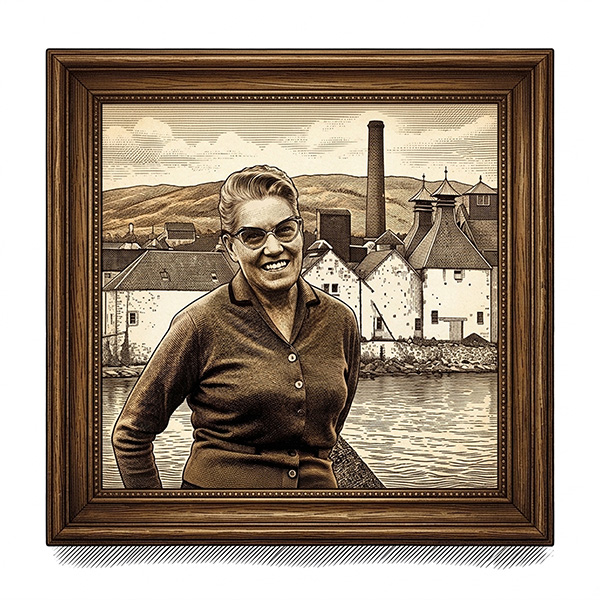
illustration of Bessie Williamson at the Laphroaig distillery

Bessie Williamson (Laphroaig)

Bessie Williamson came to Islay in the 1930s for a summer job. She stayed for the rest of her life — and ended up owning the distillery.

A Glasgow university graduate, she took a temporary post as a typist at Laphroaig, working for its owner, Ian Hunter. Hunter was the last of the Johnston family that had founded the distillery, and he quickly came to rely on her for far more than typing. She learned the business from the office out: the books, the buyers, and eventually the whisky itself.

When Hunter's health failed, she took over day-to-day management — just in time for the Second World War. Distilling ground to a halt, and the military requisitioned Laphroaig as a munitions depot, filling its buildings with ammunition and its grounds with servicemen.

The trouble was that the warehouses were still full of maturing whisky, years of stock the distillery would need to restart after the war, now sitting alongside a garrison of thirsty soldiers. Bessie stayed on to guard it, keeping a close watch on every cask so the stock wouldn't quietly disappear while the distillery stood idle. When peace came, Laphroaig still had its whisky.

Hunter had no children. When he died in 1954, he left the distillery to Bessie, the typist who had become his right hand.

She ran it for nearly two decades, in an industry that was almost entirely male, and became one of Scotch whisky's best-known ambassadors, touring the United States to promote it. She's often cited as the only woman to own and run a Scotch distillery in the 20th century.

She sold Laphroaig in stages through the 1960s and retired in 1972. The summer job had lasted forty years.

illustration of a yellow submarine

Bruichladdich WMD

Bruichladdich is a small distillery on the Isle of Islay. For a while in the early 2000s, it was also on a US government watch list.

After reopening in 2001, the distillery set up webcams so fans around the world could watch the stillhouse at work. Someone else was watching too. In 2003, as the hunt for weapons of mass destruction in Iraq dominated the news, Bruichladdich got an email from the US Defense Threat Reduction Agency, the Pentagon office responsible for tracking chemical and biological weapons. Their feed had gone down, and they wanted to know why.

It turned out the agency had been keeping an eye on the distillery. The equipment used to distill whisky is close enough to what's needed to make chemical weapons that a working distillery can look a lot like a weapons plant to the people paid to notice.

Bruichladdich did what any distillery would do: it made a whisky about it. The bottling was called WMD — Whisky of Mass Distinction — and the bottle itself was named Big Brother, after the all-seeing ruler of George Orwell's Nineteen Eighty-Four, whose face hangs on posters across the novel above the words "Big Brother is watching you." For a distillery that had just learned its webcams had an audience in the Pentagon, the joke wrote itself.

Two years later, the military gave them a sequel. In 2005, a local fisherman found a bright yellow unmanned submarine floating off Islay and towed it ashore. The Royal Navy at first said it wasn't theirs. Before long they admitted it was and came to collect it.

Bruichladdich bottled that one too: WMD II — The Yellow Submarine.

illustration of a deer

Glenfiddich

Before 1963, no distillery in Scotland sold whisky under its own name.

The entire industry ran on blends — single malts were considered too rough, too regional, and too inconsistent to sell on their own, so distilleries quietly supplied malt to blending houses and stayed anonymous.

Glenfiddich broke ranks. In 1963 it released a single malt bottled and marketed under the Glenfiddich name, betting that drinkers would pay for a whisky with a distillery's actual character instead of a blender's smoothed-out formula.

It worked well enough that competitors had no choice but to follow, and within a couple of decades "single malt" had gone from a niche curiosity to its own respected category — one Glenfiddich effectively willed into existence by being first.

illustration of flammable warning label

Hazmat

Cross 140 proof and a bourbon stops being a beverage in the eyes of shipping regulators and becomes hazardous material.

The alcohol content alone makes it flammable enough to fall under the same rules as fuel and solvents, which means high-proof bottlings — the kind distilleries release "barrel proof" or "cask strength" — are legally barred from passenger aircraft.

So while most of what's on a liquor store shelf can fly in checked luggage without issue, the strongest pours in the building sometimes can't leave the ground by plane at all.

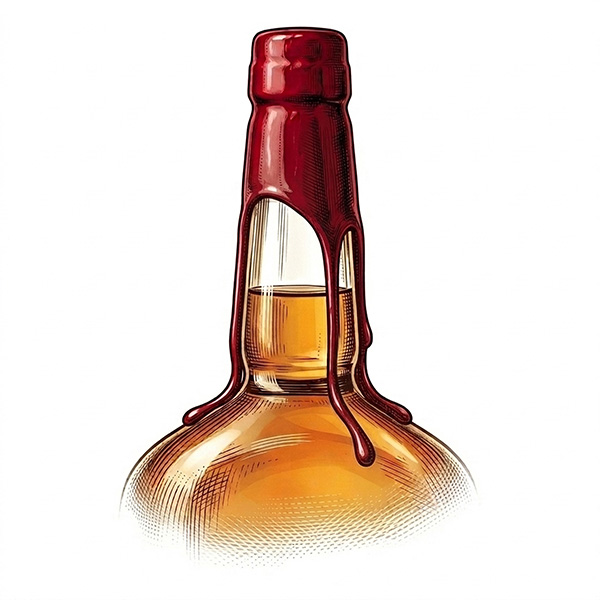
illustration of a bottle sealed with dripping red wax

Margie Samuels (Maker's Mark)

Bill Samuels Sr. came from a long line of Kentucky distillers — and then he sold the family distillery.

He knew almost immediately it was a mistake, and spent the next ten years working to get back into the business. When he finally had a distillery again, he didn't pick up where his family left off. He started from scratch: new recipe, new name, new everything.

To settle on a mash bill, he skipped the still entirely and went to the oven, baking loaves of bread with different grain percentages to taste what each one would bring. The loaf he kept coming back to used wheat in place of rye — and so the new bourbon would be a wheated one, softer and sweeter than what his family had made before.

The rest of the identity came from his wife, Margie Samuels. She collected pewter, and each piece carried the craftsman's name stamped on the back — known as the maker's mark. That became the name. She designed the bottle and the labels, drew the star-and-circle "S IV" logo, and the lettering of the brand name is her own handwriting.

Most famously, the red wax seal was her idea. She worked it out in her own kitchen with a deep fryer, adjusting the wax until the drips ran down the neck just right.

The bourbon was Bill's, but nearly everything you recognize on the shelf before you ever taste it — the name, the bottle, the handwriting, the wax — is Margie's.

illustration of a photo of Masataka Taketsuru and Rita Cowan

Masataka Taketsuru (Nikka)

Masataka Taketsuru is the reason Japanese whisky exists at all.

In 1918 he sailed to Scotland to study organic chemistry, but he spent his time apprenticing in distilleries, taking detailed notes on mashing, pot stills, and maturation that would later become the blueprint for an entire industry back home.

He also married a Scottish woman, Rita Cowan, who returned with him to Japan.

Shinjiro Torii, founder of what would become Suntory, hired Taketsuru to build the company's first distillery, Yamazaki, in 1923. The partnership didn't last — Taketsuru wanted to make whisky the Scottish way, smoky and uncompromising; Torii wanted something gentler, suited to Japanese palates.

Taketsuru left to start his own company, eventually renamed Nikka, and in 1934 built Yoichi, a distillery in Hokkaido chosen specifically because its cold, peat-rich, maritime climate reminded him of Scotland. Decades later, in 1969, Nikka added a second distillery, Miyagikyo, in Sendai — a deliberate counterpart to Yoichi, sited near a river convergence for a softer water source, built to produce a lighter, fruitier malt.

In 1985, Nikka Whisky From The Barrel is introduced. It is a blend from the two distilleries that became one of the most decorated whiskies in the world. It also contains undisclosed amounts of Scotch from Ben Nevis, a distillery owned by Nikka.

Then, in 2021, Japan's spirits association introduced formal rules defining what could legally be called "Japanese Whisky" — fully distilled, aged, and bottled in Japan, nothing imported. Whisky From The Barrel didn't qualify. Nikka had to strip the words "Japanese Whisky" off the label of one of its most awarded bottles — a whisky built on the very distilleries founded by the man who started the entire category, disowned by the label he made possible.

illustration of a maltman turning barley with a wooden shovel

Monkey Shoulder

Before malting was done by machine, it was done by hand — and it left a mark on the people who did it.

To turn barley into malt, distilleries soaked the grain and spread it across a stone malting floor to germinate. For days, maltmen worked through it with wooden shovels and rakes, turning the barley over again and again so it wouldn't overheat or tangle into a mat of roots.

It was heavy, repetitive work, shift after shift. Over time it wore down the shoulders of the men doing it, until one arm would hang lower than the other — loose and dangling, like a monkey's. The maltmen called it "monkey shoulder."

Hand malting has all but disappeared, and so has the injury. But William Grant & Sons, owners of Glenfiddich and The Balvenie, borrowed the name for a blended malt Scotch launched in 2005 — a nod to the maltmen, with three brass monkeys climbing the shoulder of the bottle.

illustration of a moonshine jug

Mountain Dew

Long before it was a neon soda, "mountain dew" was Appalachian slang for moonshine — homemade whiskey distilled in the hills, out of sight of tax collectors.

When Tennessee beverage bottlers Barney and Ally Hartman created a citrus soft drink in the 1940s, they leaned into that reputation on purpose: it was marketed as a whiskey mixer, and the name was a wink at the bootleg spirit it was meant to be poured alongside.

PepsiCo bought the brand in 1964 and, over the following decades, scrubbed the whiskey connection out of it entirely — today's Mountain Dew carries no trace of the moonshine culture its own name was built to reference.

illustration of Nearest Green

Nearest Green (Jack Daniel's)

The man who taught Jack Daniel to make whiskey was enslaved.

As a boy in the 1850s, Jack went to work for Dan Call, a preacher, storekeeper, and distiller in Lincoln County, Tennessee. The whiskey there was made by Nathan "Nearest" Green, an enslaved man whom Call told to teach the boy everything he knew. Some historians believe the charcoal filtering that defines Tennessee whiskey to this day, the Lincoln County Process, owed a debt to methods enslaved Africans brought with them, and Green was the master of it.

After the Civil War ended slavery, Jack set up his own distillery and hired Green as its first master distiller, the first known Black master distiller in American history. Green's sons went to work there too, and his descendants kept working at Jack Daniel's for generations.

Then, for more than a century, the official story left him out. Jack Daniel's became one of the best-known whiskey brands on earth, and the man who taught Jack was reduced to a footnote, when he was mentioned at all.

That changed in 2016. A New York Times article brought Green's story back into the open, and Fawn Weaver, an author and entrepreneur, set out to research it. She tracked down records, letters, and Green's descendants, and in 2017 she launched Uncle Nearest, a Tennessee whiskey named in his honor, with his great-great-granddaughter as its master blender.

Jack Daniel's now names Nearest Green as its first master distiller. It took 150 years for the label to catch up with the man who made it possible.

illustration of the Old Forester Whiskey Row bottles

Old Forester Whiskey Row

Old Forester's Whiskey Row Series is a history lesson you can pour. Each bottle is named for a year in the brand's past, and each is made to taste like the whiskey Old Forester was making then.

The series takes its name from Whiskey Row, the stretch of Main Street in Louisville where bourbon makers once kept their offices, and where Old Forester opened a distillery in 2018 on the same block it started on.

1870 Original Batch. In 1870, a pharmaceutical salesman named George Garvin Brown launched Old Forester as the first bourbon sold only in sealed bottles. At the time, whiskey was sold by the barrel and often watered down or doctored along the way; a sealed bottle was a guarantee of what was inside. Brown also blended barrels from several distilleries for consistency, so this bottling batches barrels from three different warehouses, each with its own age and character.

1897 Bottled in Bond. In 1897, Congress passed the Bottled-in-Bond Act, one of America's first consumer protection laws. To earn the label, a whiskey had to come from a single distillery and a single distilling season, be aged at least four years in a government-bonded warehouse, and be bottled at exactly 100 proof. This one follows those rules.

1910 Old Fine Whisky. In 1910, according to the brand, a fire shut down the bottling line. With mature whiskey ready to go and nowhere to put it, the distillery moved it into freshly charred barrels to wait. The second barrel gave it a darker, sweeter finish, and this bottling recreates that accidental double-barrelling.

1920 Prohibition Style. When Prohibition began in 1920, more than 200 Kentucky distilleries were forced to close. Old Forester held one of only six federal permits to keep bottling existing whiskey stocks, sold as medicine, by prescription. It never stopped. This bottling is a high-proof nod to that era.

1924. In 1924, a few years into Prohibition, Old Forester bought barrels from neighboring distilleries that had been shut down, each made to a different recipe, and bottled them as Old Forester. To honor that, this is the only bottle in the series that doesn't use the standard Old Forester mash bill of 72% corn, 18% rye, and 10% malted barley. Instead it's 79% corn, 11% rye, and 10% malted barley, aged ten years. It was first released in January 2024, a century after the barrels it commemorates, and Old Forester bills itself as the only bourbon brand made before, during, and after Prohibition.

Read in order, the labels tell the brand's story, from the first sealed bottle to surviving Prohibition.
illustration of a bottle of Old Overholt

Old Overholt

Old Overholt claims to be the oldest continually maintained whiskey brand in America, dating back to 1810, when Abraham Overholt started distilling rye on his family farm in western Pennsylvania.

Abraham's grandson, Henry Clay Frick, made his fortune outside the family business. He built a coal and coke empire, then partnered with Andrew Carnegie and became chairman of Carnegie Steel — and one of the most hated men of the Gilded Age.

In 1892, when workers struck at Carnegie Steel's Homestead mill, Frick locked them out and sent in a small army of Pinkerton agents. The gun battle that followed left men dead on both sides. Two weeks later, an anarchist named Alexander Berkman walked into Frick's office, shot him twice, and stabbed him. Frick survived and was back at his desk within the week.

Carnegie was Frick's partner in steel, but not in whiskey. Frick also owned a stake in his grandfather's distillery, and his partner there was Andrew Mellon, a Pittsburgh banker and close friend. Frick died in 1919, months before Prohibition took effect, and Mellon kept his whiskey stake quietly out of view.

In 1921, Mellon became Secretary of the Treasury — the department in charge of enforcing Prohibition. So while his agents were seizing other people's whiskey and pouring it into the gutter, Old Overholt kept selling, legally, as "medicinal" whiskey under a government permit.

The man in charge of keeping America dry was, on the side, a whiskey distiller.

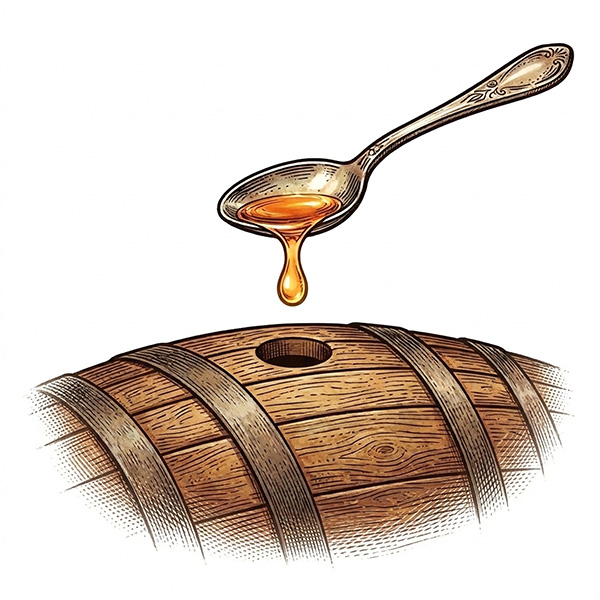
illustration of a teaspoon dropping whiskey into a barrel

Teaspoon blend

Distilleries don't just sell finished bottles — they also sell bulk malt to independent bottlers and blending houses.

The trouble is, if that malt is sold as-is, the buyer could technically bottle it as a single malt under the original distillery's name, which the distillery usually doesn't want.

The fix is almost comically small: pour in a teaspoon of whisky from a different distillery, and the contents legally stop being a "single" malt and become a blend. A splash of a few milliliters is enough to strip away the name rights — the whisky is barely changed, but its legal identity is.

It's the industry's quiet way of saying "we made this, but you don't get to say so."

illustration of a stack of wood burning

Tennessee Whiskey Exemption

Tennessee whiskey isn't its own legal category — it's bourbon with an extra step.

To earn the label, the spirit has to be filtered through sugar maple charcoal before barreling, a step called the Lincoln County Process, named for the county where it originated.

Tennessee state law requires every whiskey made in the state to go through this process to be called "Tennessee whiskey" — with exactly one exemption. Prichard's Distillery, maker of Benjamin Prichard's Tennessee Whiskey, was granted a legal exemption and skips the charcoal filtering entirely.

Phil Prichard argued for and won a carve-out by pointing to his own ancestor. His case was that charcoal filtering is not a technique his ancestor, Benjamin Prichard, ever used — and more specifically, Benjamin Prichard couldn't have used charcoal filtering, as he was making whiskey decades before the process was even invented.

So the one distillery exempted from the process is sitting right where the process was born, in Lincoln County.

illustration of a bottle of The Glenlivet

The Glenlivet

Once Glenlivet whisky built a reputation worth having, other distilleries in the region started tacking "-Glenlivet" onto their own names, hoping some of that reputation would rub off

Aberlour-Glenlivet, Macallan-Glenlivet, and more all appeared on labels that had nothing to do with the original.

The Glenlivet distillery fought this for years and eventually won the right to distinguish itself, settling on a small but permanent fix: adding "The" to its name.

It reads like a modest flourish, but it was a trademark maneuver — a definite article doing the legal work of saying this is the original, and everyone else was just borrowing the name.

illustration of the Robertson sisters

The Robertson Sisters (The Macallan)

Elspeth, Ethel ("Babs"), and Agnes Robertson inherited a controlling stake in what would become Highland Distillers, giving the three sisters a major share of the Scotch whisky business — including The Macallan.

When Seagram's came calling with an offer to buy them out, they adamantly turned it down.

Instead, in 1961, they created a holding company, The Edrington Group, to hold the shares, then set up a charitable trust — The Robertson Trust — and handed essentially all their voting shares to it.

Rather than keep the fortune, the sisters gave it away. The Robertson Trust grew into one of Scotland's largest independent grant-making charities, funding education, community development, and anti-poverty work for decades.

The Edrington Group is still steered in the sisters' name today and owns The Macallan, Highland Park, The Glenrothes, and more — a whisky empire that answers, ultimately, to a charity.